I have not felt anything at a fashion show in a long time.
I say this as someone who has sat through watching Hundred of them. The good ones, the bad ones, the ones where you leave with a buzzing skull and a phone full of blurry photos and the ones where you leave wondering why you skipped lunch. Fashion, at its highest levels, has become an exercise in brand management. The clothes come out. The celebrities sit. The photographers shoot. Everyone leaves. We call this a cultural event.
But on September 28th, under a darkening sky at Place de la République in Paris, something happened that I was not prepared for. A show stopped me. Not because it was beautiful, though parts of it were. Not because it was shocking, though it tried to be. It stopped me because it was trying to do something that almost nobody in fashion attempts anymore. It was trying to mean something. And then I looked at the clothes. And I had to reckon with what happens when a message outpaces the medium carrying it.
The brand is called Matières Fécales. In English, that translates to Fecal Matter. Yes, really. And if you think you can dismiss a label called Fecal Matter, I'd point you to the front row, where Rihanna sat in a bronze Lurex tweed suit alongside Rick Owens and Michèle Lamy. Five hundred guests waited for her, and she arrived late, because that is what Rihanna does. But nobody left.
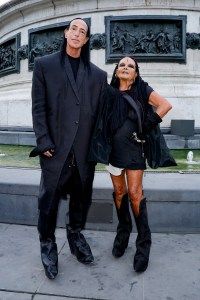
Matières Fécales was founded by Steven Raj Bhaskaran and Hannah Rose Dalton, who met at LaSalle College in Montreal around 2014 while studying fashion. They didn't like each other at first. Dalton, born in New Zealand, came from wealth and private school. Bhaskaran, queer and non-binary, grew up in Guyana and later Canada under what you might generously call precarious circumstances. He was raised by a single mother named Grace who was forced out of school at nine years old and never learned to read or write. The family shared a mattress in a small apartment in Montreal's social housing. As a boy, Bhaskaran drew his mother and sister in imaginary haute couture outfits from that mattress. That detail alone should tell you everything about the DNA of this collection.
They started selling one-off pieces on Depop. They squatted in a New York club and DJ'd on the side. They shaved their heads and their eyebrows, wore alien-like makeup and prosthetics, and built an Instagram following that now runs into the hundreds of thousands. They named their brand after waste because they believed the fashion industry produced exactly that. And somehow, a decade later, they were closing the first day of Paris Fashion Week.
The show was called "The Ninety-Nine Percent." Ninety-nine models of color. Ninety-nine looks by a designer of color. Not a single white model walked. This was, by design, a direct continuation of their previous collection, "The One Percent," which had satirized the ultra-wealthy from inside the former Paris Stock Exchange. That show drew on Dalton's privileged upbringing. This one belonged entirely to Bhaskaran.
The show ran thirty-five minutes. It unfolded in three acts, which the brand titled "Family," "Tribe," and "Gods." You have to understand that this was staged at nightfall, circling Léopold Morice's monumental statue of the Republic, inaugurated in 1883. No fashion show had ever been held at Place de la République. Bhaskaran chose it because, as he put it, it represents a sacred place for expressing opinions and celebrating togetherness, a place of revolution. He also noted that it felt right for the first fashion show there to be organized by a group of immigrants.
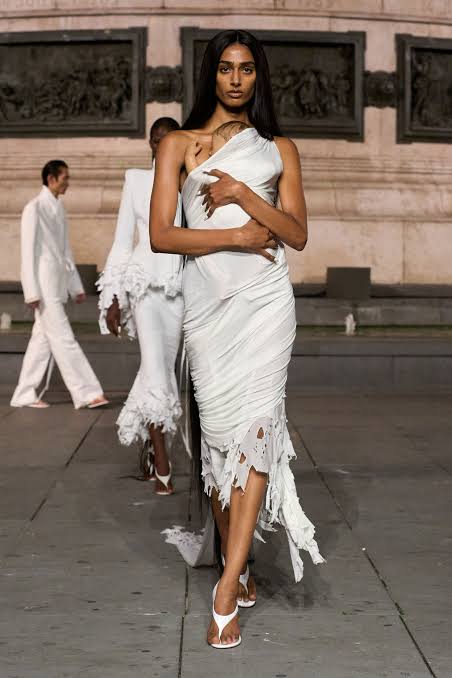
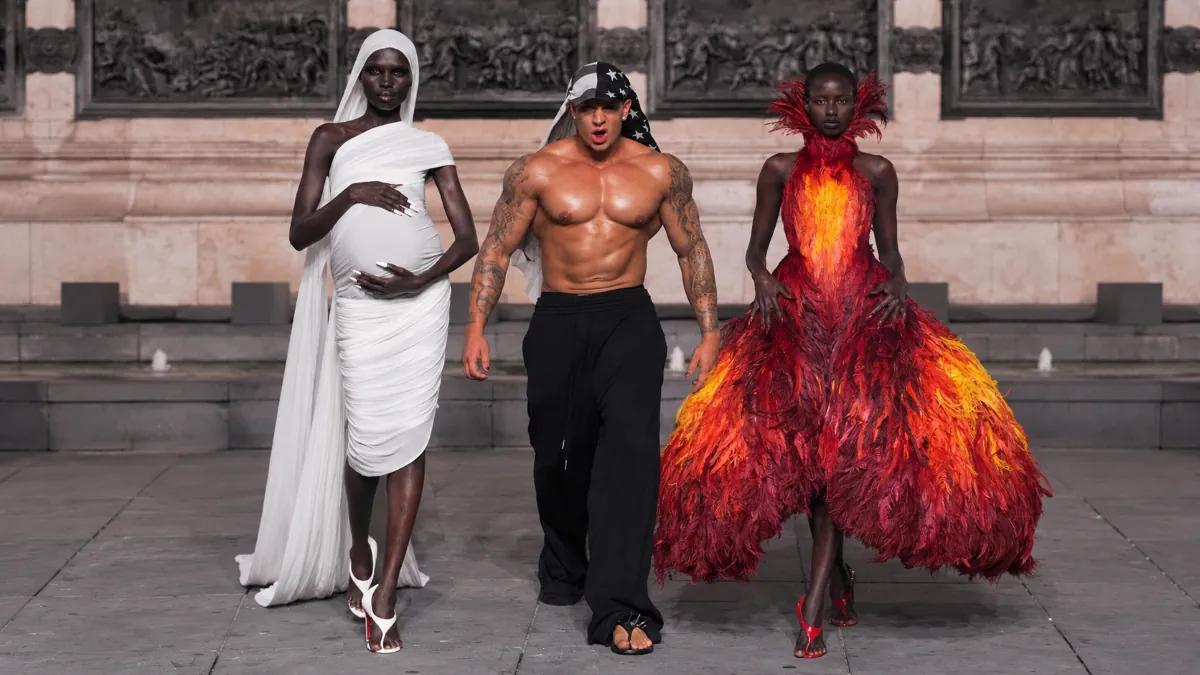
The first act opened with pregnant women in white, carrying babies on their backs. Draped silhouettes in immaculate linen and raw cotton followed, a procession that felt less like a runway and more like a ceremony. This was Bhaskaran's childhood played out in fabric. A youth shaped by poverty and religion. The clothes were almost devotional. Sculpted linen suits. Shirts drawn from the thawb, the traditional men's garment of the Middle East. Micro-pleated chiffon skirts paired with veils. Then Bhaskaran himself appeared, walking alongside his mother Grace, his sister Shandeal, and his niece, all dressed in white. His mother, who could not read, who shared that mattress with him in social housing. She walked a runway at Paris Fashion Week. It was, without exaggeration, one of the most arresting family portraits I have seen in a fashion context.
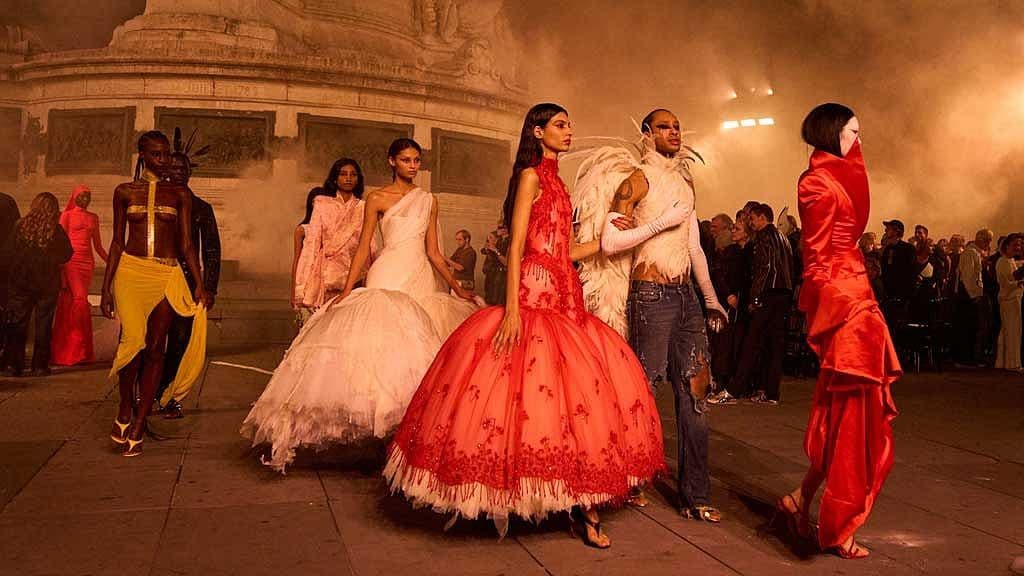
The second act exploded out of that reverence. This was the "Tribe" chapter, and it was punk to its bones. Ripped denim sewn with crystals. Military ensembles in tulle tweed. Capes in distressed lambskin. Models with prosthetic horns jutting from their faces and impossibly long curling nails. Bodybuilders. Pierced and studded people of color who looked like they had walked out of a world that fashion usually pretends does not exist. The "Stomper" combat boots hit the stone like a manifesto. On their hands, golden gloves, palms painted gold, a reference to the talents of minorities being claimed by the wealthy. T-shirts screamed "Resist" and "Uncensored."
Then three women in draped dresses of blue, white, and red stepped out, a living embodiment of the French tricolor and its promise: Liberté, Égalité, Fraternité. The crowd lost its composure.
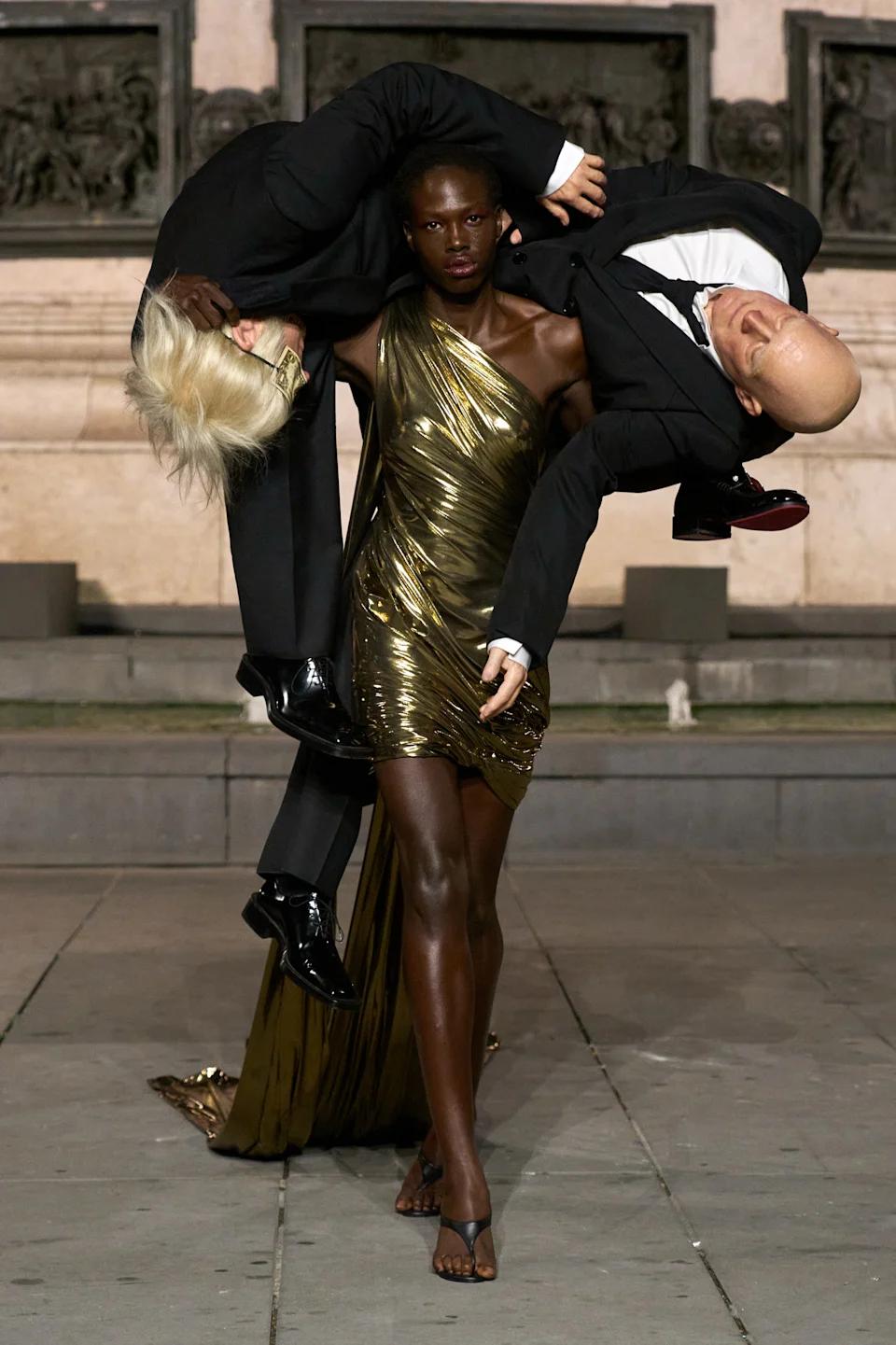
The finale was not subtle. A model in a gold lamé cocktail dress carried what looked like the corpses of two old white bankers, their lifelike figures draped over her shoulders like big game trophies. It was garish. It was provocative. And it brought the audience to a standing ovation around the statue of the Republic. In fashion these days, you almost never see that kind of collective, physical response. The industry has become too managed, too corporate, too careful for raw feeling. This show refused to be careful.
Here is where I have to be honest, because honesty is the only thing a critic has to offer.
The clothes are increasingly polished. The construction has improved enormously from their early Depop days. You can see the atelier work, the hand-embroidery, the collaboration with artisans from the Cabes GIE cooperative in Burkina Faso and the Tilfi workshop in Varanasi, India. There is craft here. There is ambition. But there is also an enormous problem. The collection, taken as a whole, is staggeringly derivative.
It is entirely normal in fashion for designers to draw from the work of those who came before them. Inspiration is part of the conversation. It always has been. What is unusual is to see an almost entire collection that reads less like an inspired conversation and more like a series of footnotes to other people's genius.
Start with the silhouettes in the third act, titled "Gods." The shapes of the jackets, the deliberately deconstructed ball gowns, are the classic Dior bar. Not referencing the bar. Not playing with the bar. The bar itself, built directly on the skeleton that John Galliano spent the better part of the late 1990s and early 2000s making legendary for the house of Dior. The nipped waist, the exaggerated hip, the sculpted shoulder. If you know fashion history, you see it immediately. If you don't, you might think these are original. They are not.
Then there is the dress. One single dress, built entirely from crimson feathers, sleeveless, high-necked, a voluminous thing that looked like it might take flight. I stared at it for several seconds before my memory caught up. It is McQueen. Specifically, it recalls the famous red ostrich feather dress from Alexander McQueen's Spring/Summer 2001 collection called VOSS, a show about beauty and what lies beneath it. McQueen built that dress from dyed ostrich feathers and glass medical slides painted to look like blood. He said there is blood beneath every layer of skin. That was his. This version at Matières Fécales is a powerful visual moment, but it is built almost entirely on borrowed architecture.
And then there are the giant oversized sweaters, the blown-up proportions, the way the knits swallowed the models' bodies. That is Balenciaga under Demna. Not in the spirit of. Not adjacent to. Nearly verbatim.
None of this is theft. Fashion does not work that way. But when an entire collection is this referential, it creates a specific tension with the message the show is delivering. You cannot claim to speak for the people who have been shut out of fashion if the visual language you are using belongs so thoroughly to the people who have always been inside it. The politics of the show say liberation. The clothes say lineage. And not always your own.
And then there was Mounia.
To understand why her appearance mattered, you need to know who she is, because fashion has a terrible habit of forgetting the people who built its foundations. Her full name is Mounia Orosemane. She was born in Saint-Esprit, Martinique, and she started her career as an airport announcer. That sentence deserves to sit with you for a moment. An airport announcer from a small town in the French Caribbean became one of the most important figures in the history of haute couture.
Her first major modeling job was at the house of Givenchy. She became the first Black model to walk a Chanel runway when Karl Lagerfeld took the helm. And then Yves Saint Laurent found her. By 1978, she was walking his haute couture show, becoming the first Black model to appear on those exclusive runways. She became his first Black muse. She was on the cover of nearly twenty major magazines. In an interview with W Magazine in 2008, she said, simply, that Saint Laurent helped open the door for Black models. He called her Moumounn.
Saint Laurent was one of the first major designers to champion Black beauty at the highest levels of fashion. He threatened to pull his advertising from Paris Vogue when it refused to put Naomi Campbell on the cover. That was the kind of designer he was. And Mounia was his anchor, his creative partner, the person who embodied his vision of a fashion world open to everyone.
At the Matières Fécales show, Mounia opened the third act. She walked out in a black tulle gown, its full skirt trailing behind her, and the entire crowd went silent. Not respectful-silence-silent. The kind of silent that happens when you are suddenly in the presence of something you did not expect. She is in her seventies now. She floated. You do not need genuine fashion literacy to understand what was happening. This woman laid down the path not just for Black people but for people of color broadly to walk in runway shows at all. She was not a nostalgia act. She was the living proof of everything the show was claiming to stand for. And she carried it entirely on her own terms.
If you want to know whether this show had a heartbeat, forget the politics, forget the prosthetics, forget the dead bankers. Look at Mounia. She was the heartbeat.
So here is the thing I cannot stop thinking about.
This show generated the kind of emotion that has become vanishingly rare in fashion. A sense of community. A collective thrill. People were crying. People were hugging strangers. The industry, which has spent the last decade perfecting the art of making you feel nothing, was suddenly full of people who were feeling everything. I applaud that. Deeply. The effort, the ambition, the willingness to put your mother on a runway in Paris and say this is where I come from, and I am not ashamed. That takes courage of a very specific kind, and I refuse to diminish it.
But there is something almost absurd about the idea of using your work to empower the 99 percent when, in fact, the 99 percent cannot afford a luxury brand. The fenced-off Place de la République held five hundred invited guests. The clothes, when they reach retail, will carry price tags that the people Bhaskaran grew up with in Montreal's social housing could never touch. The golden gloves are a commentary on the appropriation of minority talent by the wealthy. The golden gloves will also cost more than some families spend on groceries in a month.
This is not a criticism unique to Matières Fécales. It is the fundamental contradiction of every fashion brand that has ever attempted to marry social justice to a luxury price point. Stella McCartney talks sustainability while selling four-figure handbags. Virgil Abloh, rest his soul, put quotation marks around "art" and "fashion" and sold them at Off-White prices. The industry is extraordinarily good at packaging progressive values for the exact audience whose privilege insulates them from the problems being described.
Bhaskaran knows this. In interviews, he and Dalton have talked about trying to stay true to their original ethos even as they are drawn deeper into the corporate machinery of mainstream fashion. They announced that a portion of the collection's sales will go to La Maison d'Allanah, a charity. That is not nothing. But it is also not a resolution to the tension at the center of their project. You cannot dress the 99 percent in clothes that only the 1 percent can buy and call that liberation without a very large asterisk.
And yet.
And yet there was Mounia, walking in her black tulle gown at seventy-something years old, and the silence was total, and for a moment the price tags did not matter. There was Bhaskaran's mother Grace, who cannot read, standing on a runway in Paris in white, and the gap between where she started and where she stood was so vast it made the room ache. There was the boy on the mattress, drawing his family in clothes they could never afford, and twenty years later making those clothes real and putting them on her body.
Fashion does not often give us stories like this. It gives us products. It gives us campaigns. It gives us carefully calibrated brand narratives designed to convert attention into revenue. It almost never gives us a human being standing in front of us saying: this is my wound, and I turned it into a dress.
Matières Fécales did that. The message was staggering. The fashion itself needs to catch up. The revolution walked the runway. Now the clothes have to earn the right to carry it.