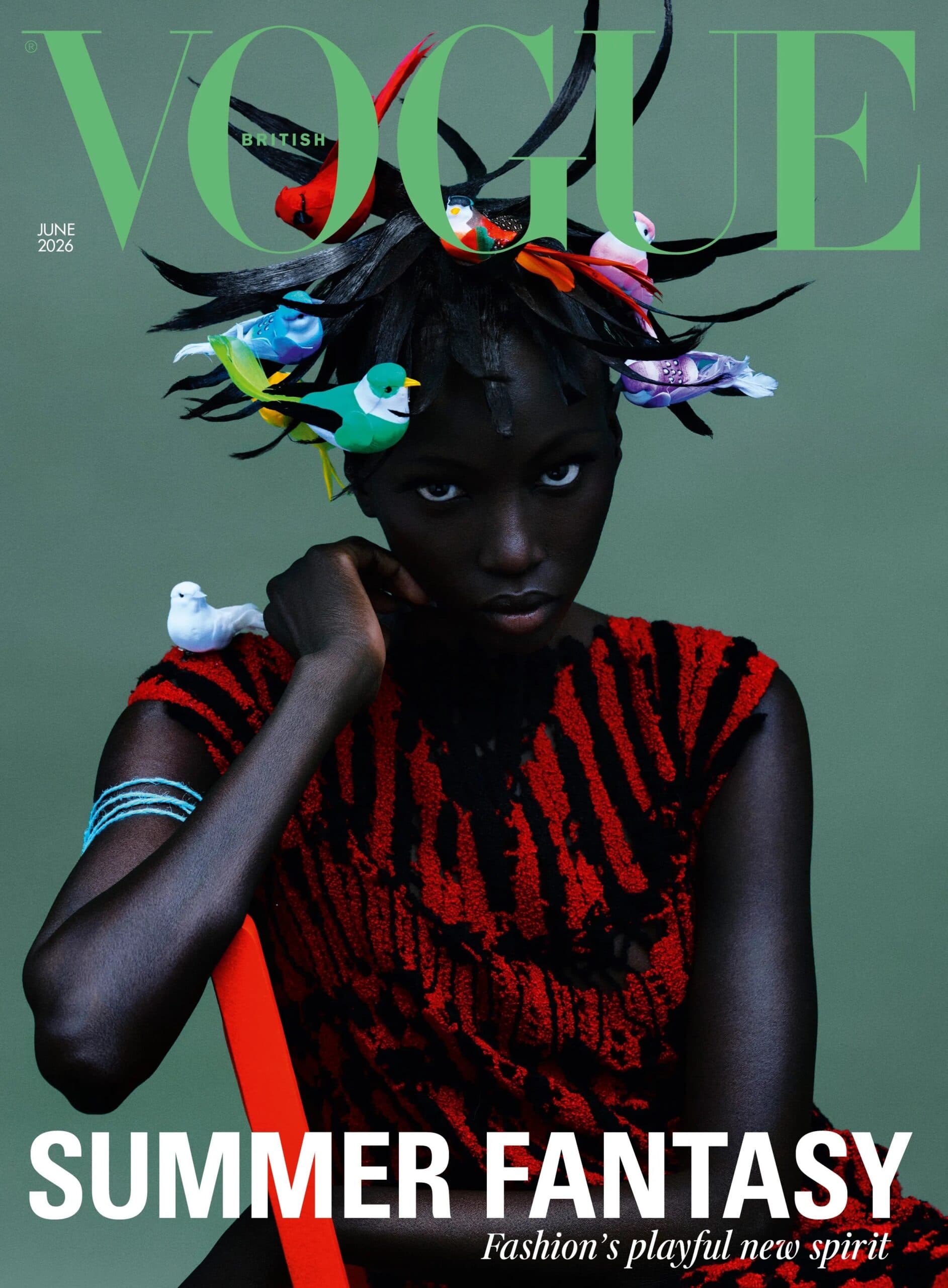
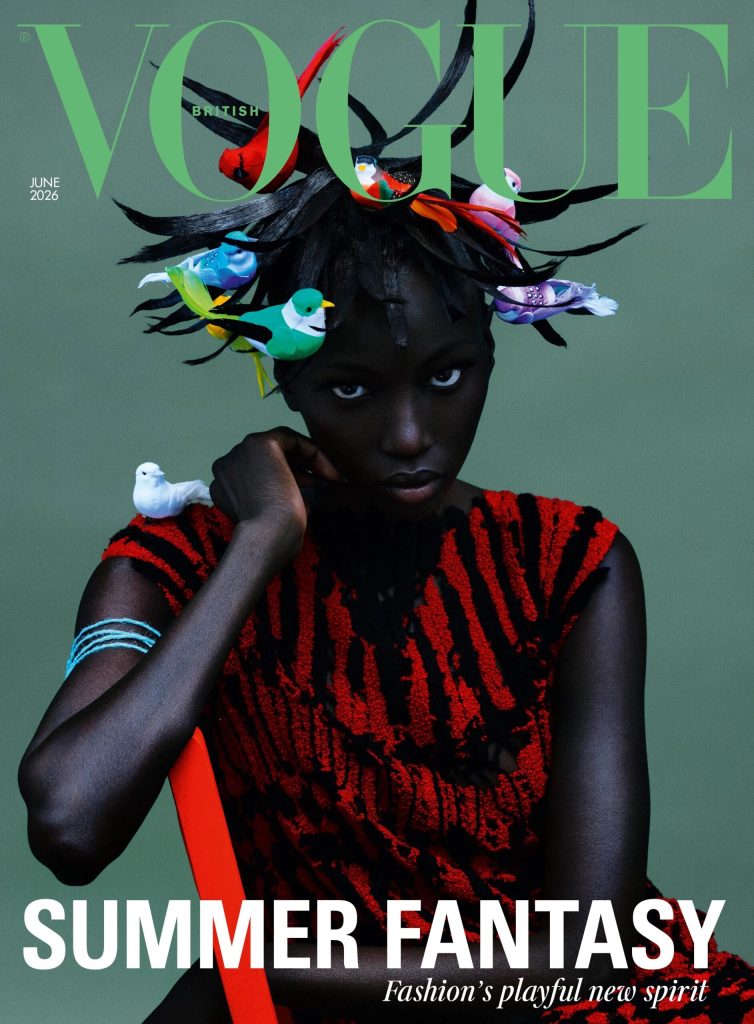
The June 2026 cover of British Vogue does not whisper. Photographed by Rafael Pavarotti and styled by Kate Phelan in a silk-knit dress from Matthieu Blazy’s debut Chanel collection, Anok Yai stands against a green studio backdrop and looks directly into the lens. Not through it, either not past it but directly into it. And the effect, as forum members on theFashionSpot put it within hours of the cover’s release, is simply sensational. The word keeps coming up-Sensational. As though the people reaching for language to describe her keep arriving at the same one and finding it accurate.
What makes this cover more than a beautiful photograph is the tale behind it. Anok Yai on the cover of British Vogue in 2026 is a woman who was born in a refugee camp in Cairo, raised in Manchester, New Hampshire, and discovered at a Howard University homecoming in 2017 by a photographer who simply asked to take her picture. She was 19 years old and studying biochemistry, her goal was to be a doctor. She did not go on to be a doctor. Chose a different path, somewhere no one had quite gone before.
WHERE SHE COMES FROM.
Anok Yai was born on December 20, 1997, in Cairo, Egypt, to South Sudanese Dinka parents who had fled the civil war tearing their country apart. Her family are Christian refugees, displaced by a conflict so prolonged it became one of the longest civil wars in recorded history. When Anok was around three years old, her family resettled in the United States, first arriving in New York before moving to New Hampshire, which offered more support for immigrant families starting over. Her mother became a nurse, and her father found work at Easterseals, an organization that supports people with disabilities. They built a life from opportunity offered, similar to many refugee families, with long shifts and quiet determination and the particular faith of people who had survived the worst.
Anok grew up watching that faith. She absorbed it. And when she sat down in 2021 to speak with Forbes about what her family’s journey meant to her, she did not reach for abstraction. She said plainly: “Had we not been given government assistance, I don’t know where we would have ended up.” This is a woman who remembers where she comes from. That is not a small thing. Which is, in fact, the whole story.
THE PHOTOGRAPH THAT CHANGED EVERYTHING.
In October 2017, photographer Steve Hall attended Howard University’s homecoming week and saw a young woman in the crowd whose face stopped him. He asked to take her picture. She said yes. He posted the photograph to Instagram and it collected over 20,000 likes almost immediately. Modeling agencies, including IMG Models, came calling within days.
Anok signed with Next Models. Four months later, she opened the Prada Fall/Winter 2018 show in Milan, becoming the first model of South Sudanese descent and the second Black model to open a Prada show in the brand’s history. The first had been Naomi Campbell, 21 years earlier, in 1997. Twenty-one years. That gap is not an accident. The gap is a policy. And Anok Yai, who had no idea she was making history until the day after, said something about that moment that tells you everything about who she is. “When it happened, I had no idea I was the first Black model since 1997. I found out the next day. Ever since that show, I have seen other designers follow. I’ve seen a lot more Black models backstage opening and closing shows. It was a huge stride. There are strides we still have to make, but this is a positive one.”
Not a victory lap. A stride. And an honest acknowledgment that the work is not finished. This is the quality that separates Anok Yai from the standard celebrity narrative. She does not perform gratitude, nor does she perform humility. She tells the truth.
WHAT SHE DID WITH THE DOORS SHE OPENED.
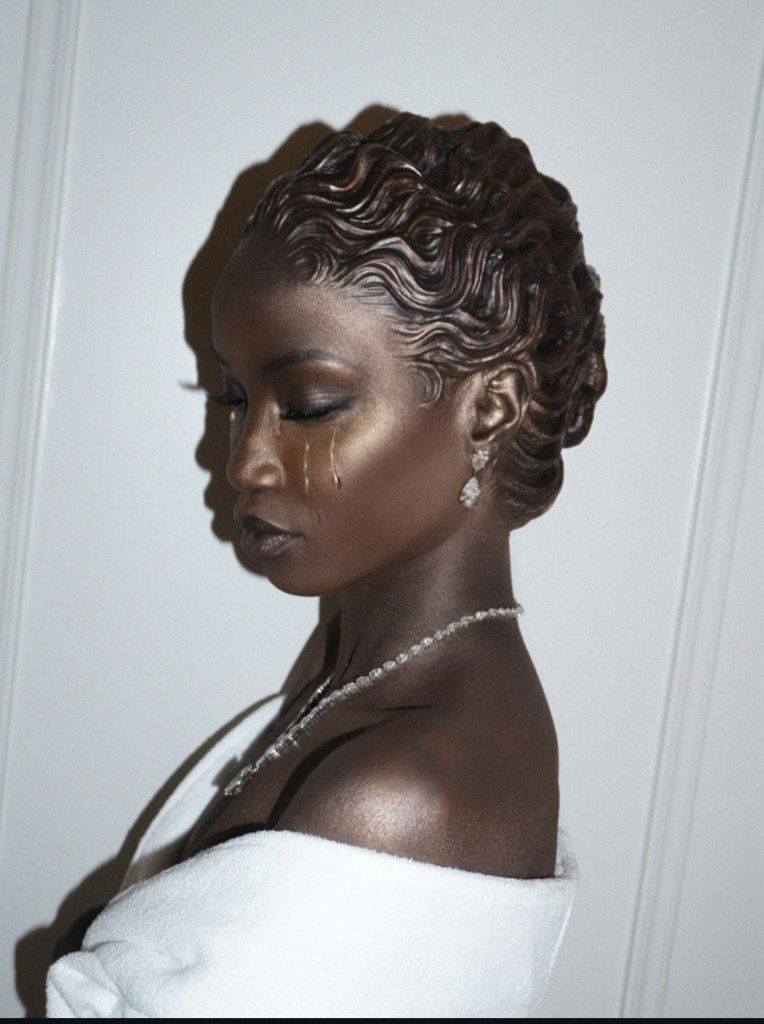
After Prada, the industry came to her. Versace, Saint Laurent, Mugler, Givenchy, Calvin Klein, Tom Ford, Bottega Veneta. In 2025 alone, she opened shows for Coperni, Ferragamo, and Hugo Boss, and closed shows for Fendi, Ralph Lauren, and Vetements. She walked in Matthieu Blazy’s first Chanel show. Also appearing on the covers of Vogue France, American Vogue three times, Allure, and Perfect. She starred in campaigns for Gap and Mugler’s Alien fragrance. At the 2024 Met Gala, she arrived in a custom Swarovski gown encrusted with 98,000 crystals and metallic chrome body paint that made her look like a living monument. At the 2025 Met Gala, she wore Thom Browne, a master class in tailoring that reset the bar she had already raised. TIME named her one of the 100 most influential people in the world in 2026.
But the career is not the story, it is the evidence. The story is what she chose to do with the platform all of it created.
Anok Yai’s goal, stated plainly in interview, is to make dark-skinned beauty an everyday thing. Not a statement or a trend. An everyday thing. She understands the difference between being celebrated as exceptional and being seen as normal, and championing the second one. She speaks openly about colourism in the fashion industry, about the microaggressions she has witnessed, about an industry that has historically treated dark skin as a rare item rather than a standard. Criticising these unfair treatments with acerbity.
USING THE STAGE FOR MORE THAN FASHION.
On December 1, 2025, at London’s Royal Albert Hall, the British Fashion Council named Anok Yai the 2025 Model of the Year. She walked onto that stage in a custom white and ivory satin corset gown by Dilara Findikoglu, a mermaid silhouette with a draped skirt and ruffled train, and she did something that most people at fashion awards do not do, openly thanking her team with the microphone.
Standing in front of the entire fashion industry, she called for peace in Sudan. Called out the massacre happening and that her family was dying. She called on the United States government to protect South Sudanese refugees whose temporary protected status was being terminated by the Trump administration. She said, “I don’t know what to do.” Six words that had no place in a fashion awards speech and were exactly the right words to say.
Then she posted on Instagram that night alongside photos from her childhood, a sweet shot with her mother among them, and she wrote: “Mama, I think we made it.”
Both things at once. The grief and the gratitude. The political urgency and the private tenderness. This is who she is. She does not choose between them. She carries both because both are real, and she has never pretended otherwise.
Her advocacy extends beyond the podium. Persistently vocal about refugee rights and the systems that support immigrant families, drawing directly from her own experience of what government assistance meant for her family’s survival. Advocating about mental health and the cost of overworking in an industry that rewards relentlessness. She told ELLE in 2024 that she spent three straight months either on a set or in a hotel, only coming home to repack her suitcase, and that she knew she had gone too far. Telling her story not as a badge of honor but as a warning. That, too, is a form of advocacy.
THE WEIGHT OF A FIRST
There is something that happens when a young dark-skinned girl of South Sudanese descent sees Anok Yai on the cover of British Vogue. The same thing that happened when a generation of Black women saw Naomi Campbell open for Prada in 1997. The thing that happens when the world shows you that your face belongs somewhere you were told it did not.
Anok Yai knows this. She carries it. When she accepted the Model of the Year award, she said: “This recognition is for everyone who has ever seen their story in mine. Thank you for celebrating us.” Not me. Us. She has never once pretended that she arrived alone or that her success is only personal. Seeing her visibility as a shared resource, something that belongs to every girl who has ever felt unseen.
She also treats excellence as the standard. Not the exception. Not the remarkable-given-the-circumstances. The standard. Her presence on the cover of British Vogue is not remarkable because she is from South Sudan. It is remarkable because the photograph is extraordinary, the woman inside it has earned every inch of that cover, and the story behind it is one of the most genuinely beautiful things the fashion industry has produced in years.
WHAT COMES NEXT
The British Vogue June 2026 feature, written by Funmi Fetto, is described as deeply personal. Photographed alongside her parents, Anok opens up about confronting mortality, the importance of family, and what it means to rebuild after difficulty. The editorial, spanning pieces from Chanel, Mugler, Loewe, Calvin Klein, and Marc Jacobs, was built around the theme of rebuilding a life in colour. That phrase lands differently when you know her history. When you know that colour, specifically the deep, luminous, extraordinary depth of her skin, is the very thing the industry spent years treating as a problem to be managed.
She turned it into the whole point.
Anok Yai is 28 years old. She has opened Prada, covered Vogue, walked for Chanel, stood at the Royal Albert Hall and spoken truth into a microphone. A girl born stateless who grew up in New Hampshire. Discovered at a homecoming. And somewhere in there, in all of that ordinary extraordinary life, she became the person that the fashion industry, when it is being its best self looks at and says: this is what we were always supposed to be doing.
She walked into the room and the room changed. That is the only sentence you need. Everything else is evidence.