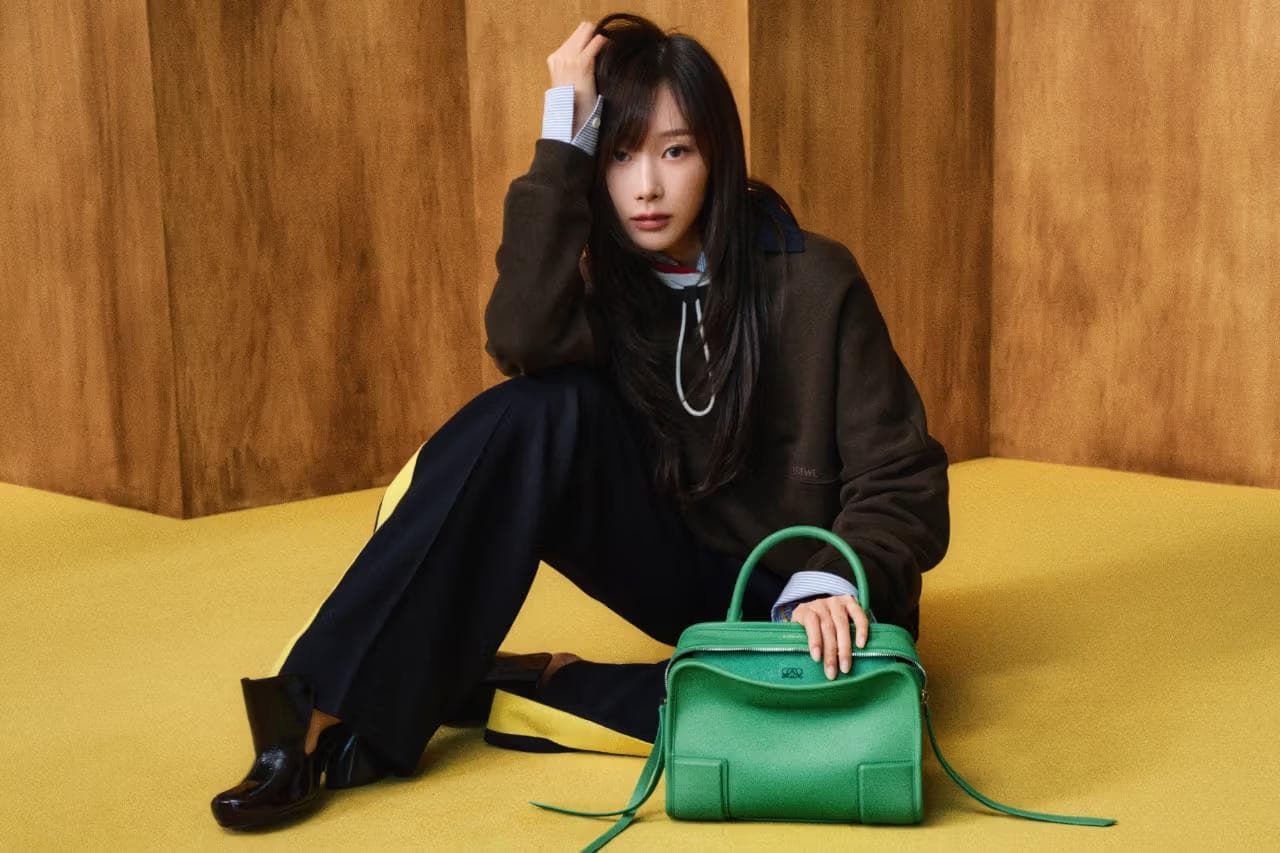
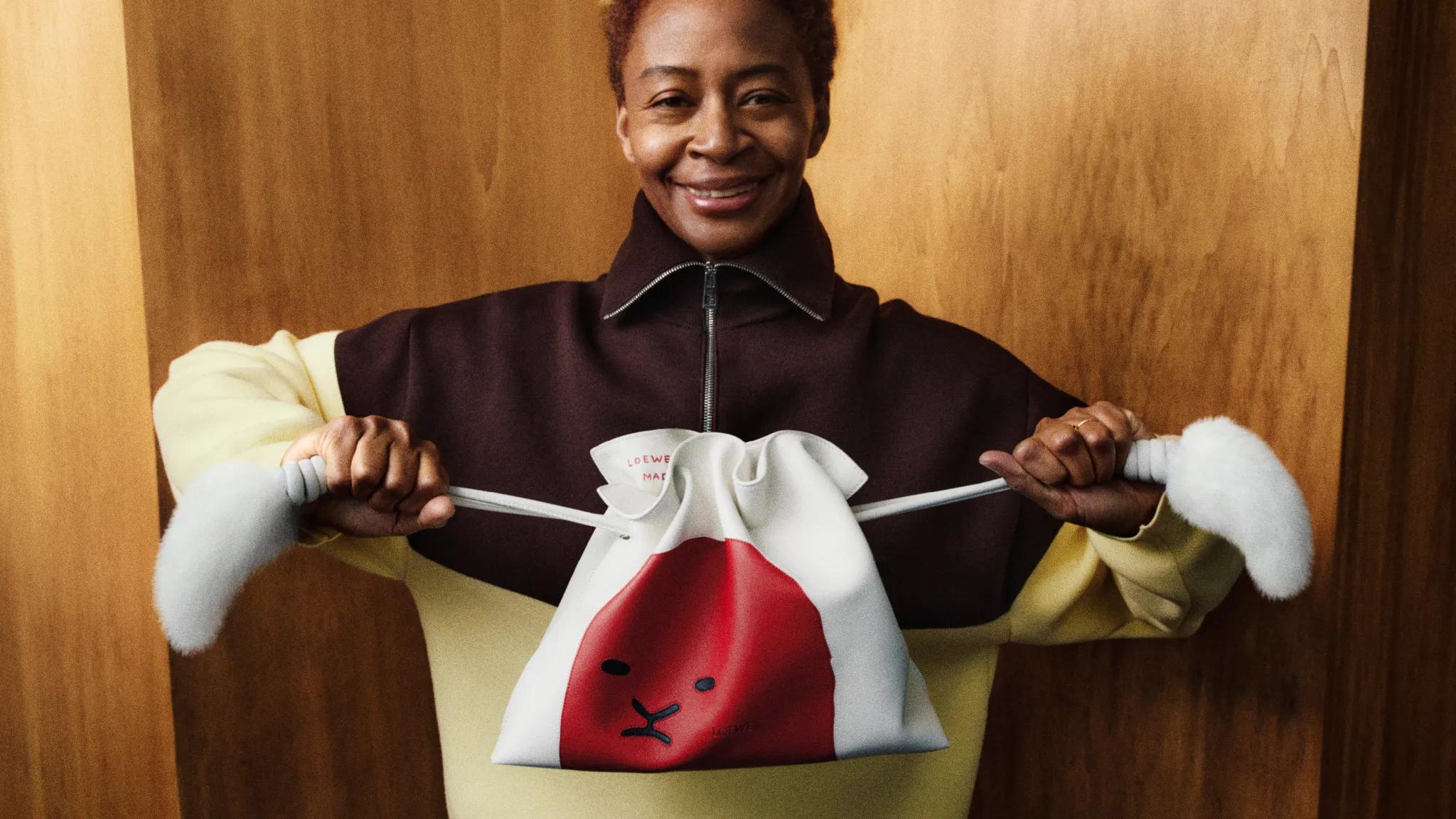
On June 1, Loewe put six women in a warm, wood paneled room and asked a photographer named Talia Chetrit to make it look like nobody had planned anything. Julia Garner is there, thirty one years old, three months into her contract as global ambassador.
Sissy Spacek is there too, a woman whose film career started before Garner's parents were born. Aespa's Giselle is there, holding a bag toward the camera the way idols are trained to. Salma Abu Deif, one of Egypt's most recognized actresses, is there, her presence in a Madrid marketing campaign meaning something different in Cairo than it does in the room LVMH built for this shoot. And Kara Walker is there. An artist who has spent three decades cutting black paper into silhouettes about slavery, plantation violence, and the stories white America tells itself to sleep at night, standing in Loewe apparel with a leather bag traced back to a German merchant who opened a workshop in Madrid in 1872.
Nobody at Loewe is going to explain that pairing to you. It is worth sitting with anyway.
Start with what the campaign is actually for. Loewe turns 180 this year, which makes it the second oldest luxury house still operating, a fact the brand has repeated in nearly identical language across a press release, an animated short narrated by Antonio Banderas, and a special June 15 issue of Loewe Magazine called 180 Years of Craft. But the real occasion being marked is not the anniversary. It is the transition. Jonathan Anderson, who ran the house for eleven years and turned it into an art world darling through collaborations with Lynda Benglis and Richard Hawkins, left last year for Dior. In his place, Loewe installed Jack McCollough and Lazaro Hernandez, the duo who spent two decades building Proenza Schouler into a critical favorite that never quite became a commercial juggernaut. Their debut Loewe collection landed in October. This campaign is their second real public statement, and it is doing something a first collection cannot do on its own: it is buying trust with history the two men did not build.
That is what an anniversary campaign is for. Not nostalgia. Insurance. Loewe SA closed 2024 with revenue of 885.2 million euros, up 9.2 percent on the year before, inside an LVMH portfolio that also holds Dior, Louis Vuitton, and Bulgari. A house growing at that rate does not need to prove it can sell handbags. It needs to prove that new hands can be trusted with an old name, and the fastest way to do that is to surround the new hands with everything the old name has already earned. Hence the Flamenco clutch from the 1980s. Hence the Puzzle bag from 2015, the one accessory of the Anderson era secure enough to survive a regime change untouched. Hence the centerpiece, the Amazona 180, a reworking of a bag first sold in 1975, now rebuilt in softer calfskin and suede by McCollough and Hernandez for their debut collection and positioned here as the thesis of the entire campaign.
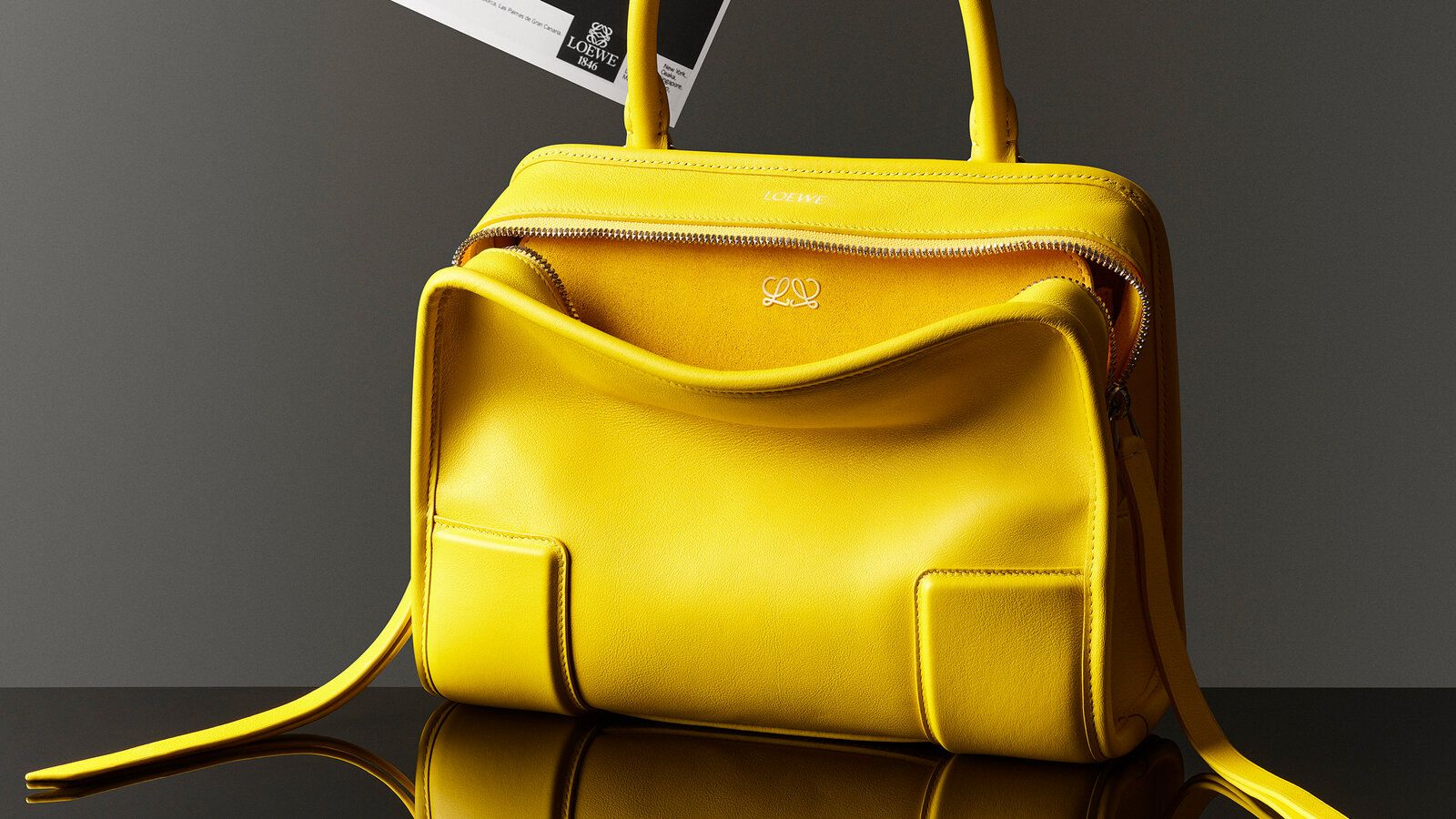
The original Amazona is being sold back to the public with a specific story attached. Loewe Magazine's companion issue frames the 1975 bag inside the social and political context of 1970s Spain, tying its boxy, structured silhouette to the changing role of women in a country still climbing out of Francoist rule. That is a real historical current, and it is also a convenient one. A bag becomes a feminist artifact the same year the house needs a symbol sturdy enough to carry two new creative directors on its back. The metaphor was sitting right there. Someone in Loewe's marketing department found it and used it well.
Which brings the conversation back to Kara Walker. Her inclusion is not incidental. The campaign's stated ambition, according to Loewe's own framing, is a cast that spans generations and disciplines, and Walker's presence does real work toward that goal, the same way Sissy Spacek's does, the same way a K-pop idol's does for an entirely different audience segment. But Walker is not a generic art world credibility hire. Her entire body of work interrogates how institutions launder violent histories into palatable heritage, how the past gets edited on its way to becoming a brand. Loewe put that artist in a room built to launder its own 180 year old history into something palatable for 2026, and either nobody on the creative team clinched the irony or somebody did and decided it would read as sophistication rather than contradiction. Both readings are plausible. Neither one is flattering.
None of this makes the campaign bad. Talia Chetrit's images are restrained in a way most anniversary marketing is not, no crowded retrospective, no forced nostalgia, just six people and some very good leather in a controlled room. The Impression called it exactly right: the message is that heritage matters only if it stays relevant, and McCollough and Hernandez clearly understand that a 180 year old house dies the moment it starts behaving like a museum. What deserves scrutiny is not the craft. It is the function. Every element, the lion motifs referencing the literal translation of the Loewe name, the Banderas narration walking through 1872 and 1905 and 1988 like a highlight reel, the free magazine handed out in stores, is built to answer one question before anyone gets the chance to ask it out loud. Can these two Americans actually run this house.
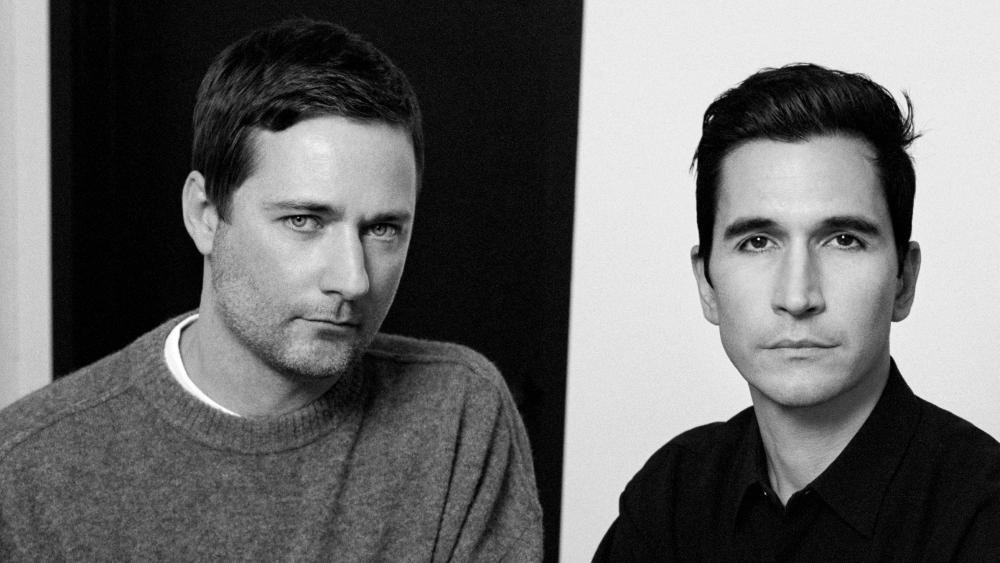
The answer the campaign gives is: look how much history is standing behind them. Whether that history was earned by the two men currently wearing it, or simply inherited the way a surname is inherited, the campaign never quite says. It does not have to. That is the whole function of an anniversary. It replaces a question with a number, and 180 is a very large number to argue with.
What Cohesive readers should take from this is not a verdict on two designers eight months into a new job. It is a template. Watch what any legacy house does in the first eighteen months after a creative director change, and count how many of its public gestures point backward instead of forward. Anniversaries, archive exhibitions, magazine supplements, animated retrospectives narrated by a beloved actor born in the same country the brand was founded in. Each one looks like celebration. Each one is also doing quiet, deliberate work, converting inherited doubt into inherited authority before the new regime has to earn either one on its own.
Loewe will be fine. The bags are good, the campaign is well made, and 885 million euros of revenue does not evaporate over one succession. But the next time a house this size stages a birthday, it is worth asking who the party is actually for. It is rarely the customer.
Consider what happened right before this house made the same move. When Anderson took over Loewe in 2013, there was no anniversary to lean on, no magazine supplement, no Banderas narration waiting in reserve. He built the art world credibility from nothing, one Lynda Benglis collaboration at a time, across eleven years, until the credibility became inseparable from the man himself. McCollough and Hernandez do not have eleven years. They have a fiscal calendar and a parent company that reports quarterly, and 180 was always going to arrive whether they were ready for it or not. Reaching for it was not cynical so much as inevitable. Any creative director handed a house this old, in a market this unforgiving, would have pulled the same lever. What deserves notice is not that Loewe used its history. It is how cleanly the machinery worked, how little friction showed in the final images, and how easily six unrelated careers folded into a single story about continuity that not one of them actually lived through. That is craft too. Just not the kind the magazine supplement is selling.