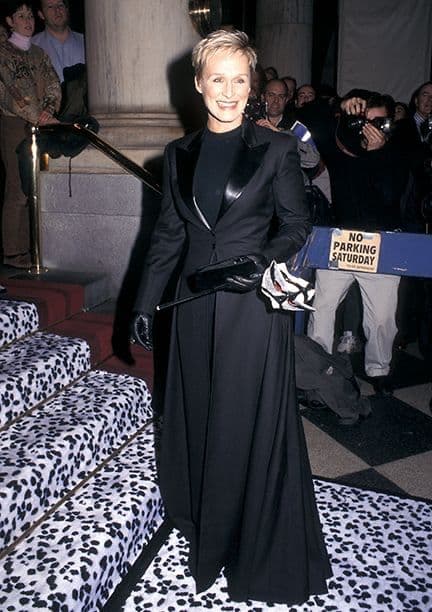
“The Meaner she was, the better she was” – Glenn Close, on playing Cruella de Vil.
In 1996, Anthony Powell, a British costume designer who had already won three Academy Awards, built a wardrobe for a fictional fashion villain. He sourced feathers and animal skins and sequined fabric. Constructed a 21-inch corset so tight that the actress wearing it would risk losing consciousness between takes. He designed pieces that now live in a permanent museum collection at Indiana University, studied and preserved as fashion objects rather than film props. He was not slumming, doing what he had always done. Building a character from the outside in.
The character was Cruella de Vil. The film was Disney’s 1996 live-action 101 Dalmatians. The actress was Glenn Close, who had quietly negotiated a clause into her contract allowing
her to keep every single garment when filming ended. Disney was not pleased. They offered her copies. She took the originals.
I have been thinking about this because The Devil Wears Prada 2 arrived in cinemas and the reviews have been what the reviews always are when a sequel comes to rescue a mythology that needed no rescuing: mixed, a little confused, and quietly sad. The original 2006 film is a genuine achievement. Meryl Streep’s performance is extraordinary. Patricia Field’s work is canonical. Nobody is disputing that. What I want to dispute is the premise, repeated so often it has started to feel like fact, that The Devil Wears Prada gave fashion its first real villain. That Miranda Priestly invented something. That 2006 was when cinema figured out a woman in couture could be dangerous.
Glenn Close did that ten years earlier. She did it in a corset she nearly fainted in, wearing clothes she fought contractually to keep, playing a character who ran a fashion house and organized her entire existence around a single, violent aesthetic obsession. We just chose not to remember it that way.
The reframing of Cruella de Vil as a fashion designer in the 1996 film was, as costume scholar Kelly Richardson later described it, a genius move. In the original 1961 animated film, Cruella is a fur-obsessed socialite. A cartoon excess. In the live-action version, she has a fashion house, a staff, a design philosophy, and a wardrobe that articulates all of it without a single line of dialogue. Powell understood that the redesign meant the costumes had to carry ideological weight. The silhouettes are not merely extravagant. They are declarative. The zebra print Cossack coat with banded mink sleeves and a high collar does not say I have money. It says I have decided what beauty is and I will not be debated. The red ostrich-feather gown does not
say excess. It says consumption. The black-and-white silk gown with sharkfin applique does not say dressed. It says armed.
Close worked with this. She has spoken about understanding early that the character did not require interior psychology. The evil was the point. The clothes were the truth. What the role required was not analysis but total physical commitment, and she gave it. A 21-inch waist inside a corset that, if it ran even a few millimeters too small, caused her to lose consciousness on set. High heels for the entire shoot. A two-hour makeup call every morning. She endured all of it with the specific focus of someone who understood that the physical transformation was not a detail of the performance. It was the performance.
“Miranda Priestly uses fashion. Cruella de Vil is fashion. One wears it as armor. The other cannot exist without it.”
When Disney found out the cost of what Powell had built and discovered the contract clause, they were unhappy. Close declined the replicas and walked away with the originals. The entire Cruella wardrobe from both the 1996 film and its 2000 sequel now lives in the permanent collection at Indiana University’s Eskenazi Museum of Art, as part of The Art of the Character: Highlights from the Glenn Close Costume Collection. Scholars study it. Curators treat it with the same seriousness as pieces from actual fashion houses. This is not coincidence. This is what happens when costume design is done at the level of authorship.
So why does Miranda Priestly get the mythology and Cruella de Vil get the Halloween costume?
Part of the answer is timing. The Devil Wears Prada arrived in 2006, exactly when the fashion industry was becoming legible to people who had previously been locked outside it. Lauren Weisberger’s novel gave a generation permission to be fascinated by a world that had always treated fascination as trespass. Miranda Priestly became shorthand fast. Shorthand travels. The clipped sentences, the coat on the desk, the imperious silences: these images compress easily into the cultural vocabulary of power. They spread because they can be repeated without context.
Cruella de Vil resists compression. She is not a type. She is a specific. A woman whose obsession is so total and irrational and structurally organized around a single violent vision that she cannot be summarized in a moment. She does not drop a coat. She nearly faints in a corset. The scale of difference is the scale of the entire argument.
Anthony Powell died in London in April 2021, at 85. He had spent five decades building characters out of fabric for Roman Polanski, Steven Spielberg, George Cukor, and dozens of others. His obituaries were respectful. They were also mostly short. The industry does not know how to mourn costume designers with the fullness they deserve, because the industry has never fully accepted that costume design is authorship. Kevin Lima, who directed 102 Dalmatians, said of Powell: he has to look deep into these characters and visualize them, he does not just perceive what they wear but who they are, and he creates layers of character from their clothing. This is a precise description of what the craft is at its highest level. Powell did not dress Cruella. He built her.
Patricia Field built something too, on The Devil Wears Prada. Her work is brilliant and influential and has been recognized accordingly. The credit conversation does not need to be zero-sum. Both women deserved flowers. What does not work is the erasure of one in favor of the other?
“Cruella de Vil walked so that Miranda Priestly could run. We built a shrine to the student and forgot the teacher.”
The sequel’s mixed reviews have made this conversation more pointed. The Devil Wears Prada 2 is, by most accounts, a film about obsolescence. Miranda Priestly in 2026 is a woman whose world has passed her. Her power is eroding. Her certainties are failing. This is dramatically interesting. It is also revealing: a character whose authority was always institutional, always tied to a specific moment in magazine publishing, always dependent on the architecture of a particular industry’s gatekeeping, cannot survive intact when that
architecture collapses.
Cruella de Vil’s wardrobe does not have this problem. Obsession is not institutional. It does not expire when the industry changes. The wanting that drives Cruella is not contingent on fashion week calendars or editorial hierarchies. It is something older and more honest about what fashion actually is at its core. Desire so total it requires everything and stops short of nothing.
That is not comfortable. It is not aspirational in the conventional sense. You cannot acquire Cruella’s certainty by buying the right things. You can only watch it and recognize, somewhere in yourself, the part that knows exactly what she means when she says she lives for furs. Substitute furs for whatever you have given yourself entirely to. The grammar is the same.
There is one more detail that does not get enough attention. When 101 Dalmatians went into its press tour, Close did not show up as Glenn Close. She showed up as Cruella. In the clothes. With comedy writers beside her to keep the character alive in public. This is an unusual choice for a Disney family film. It is also a philosophically coherent one. If the clothes were the performance and the performance had been total, then stepping out of them for a press junket would have been a kind of lie. Close did not tell that lie. She wore the character past the set and into the real world because there was no clean seam between them. That is not professionalism. That is possession.
The fashion designers who have actually changed what we see when we look at clothes have mostly operated from the same place. McQueen. Galliano at his peak at Dior. Alaia, who kept his atelier closed to the press and his collection on his own schedule because the schedule he
was on was the schedule of the work itself, not the industry’s calendar. These are not power dressers. These are people for whom the vision was so total it left no room for the question of whether the outside world agreed. The industry celebrates them now, loudly and profitably. It usually waited until they were out of the way first.
Cruella de Vil is the cinematic version of what those designers were in life. Someone who could not exist outside the clothes. Someone whose wanting was not a personality trait but a structural condition. The film is not a great film. Nobody is arguing that it is. What it contains, inside its middling plot and its broad comedy, is a performance of genuine rarity and a wardrobe of genuine seriousness. We have spent thirty years treating both as the warm-up act for something that came a decade later and did less with more.
Fashion criticism has a pattern of preferring the story it can tell at a dinner party to the story that requires sitting with something uncomfortable. Miranda Priestly is the dinner party story. She is aspirational, quotable, and ultimately reassuring because the kind of power she holds is a kind we recognize. We have had versions of her as a boss. We understand her architecture. Cruella de Vil is the story that requires sitting with something uncomfortable. Her obsession is not relatable. It is not transferable. It cannot be turned into a listicle or a reductive quote or a mood board. What it can be turned into is the most honest image of what fashion has always been at its most serious: irrational, consuming, and absolutely certain of itself.
That certainty is what the industry has spent decades trying to manufacture and rarely manages to produce. It cannot be bought or briefed or trend-forecasted into existence. It comes from the same place Close’s corset came from. From someone deciding that the vision is worth the fainting.
Glenn Close was that girl first. She nearly fainted for it, negotiated for the originals. She wore the evidence of what Anthony Powell built into her body and then kept it, because she understood that you do not let originals go.
The least the culture can do is stop handing the credit to someone else.