Move over, white tee. I spent this summer being out-argued by a top I will never wear, and I am man enough to admit when a neckline has beaten me.
The first one I remember properly was at a family friend’s wedding. Her wedding was in 2024, July, the hottest Saturday of that summer, and I have known her since we were children, and I like her enormously, the way you like a person who has known you through every bad haircut. When the dancing started she changed out of the gown and into a white halter dress with a knot at the neck, and she stood under the string lights looking like the entire day had been waiting for her to do exactly that. I remember thinking two things. She looked like the happiest person in the postcode. And the halter was doing more work than the gown.
That was the first time the halter stopped being a costume in my head and became a decision a happy person makes. I have been professionally interested in women’s clothing for a long time, and I had never seen a neckline work that hard. Let me state my position, since most writers on this beat will not. I have never worn a halter top. I have the neck for it and I lack the nerve, which I mention because my testimony here is that of a witness, and a witness has to say where he was standing. I was standing at the edge of it, all summer, watching a garment win, and it has taken me until August to admit the score.
Since the dawn of what we rather grandly refer to as “fashion”, women have been dressing their shoulders for an audience. Feathers on a collarbone, a strap crossed at the neck, an open back catching the light: you name it, they’ve worn it. We men have spent most of that same history deciding between two shades of navy and calling it personality.
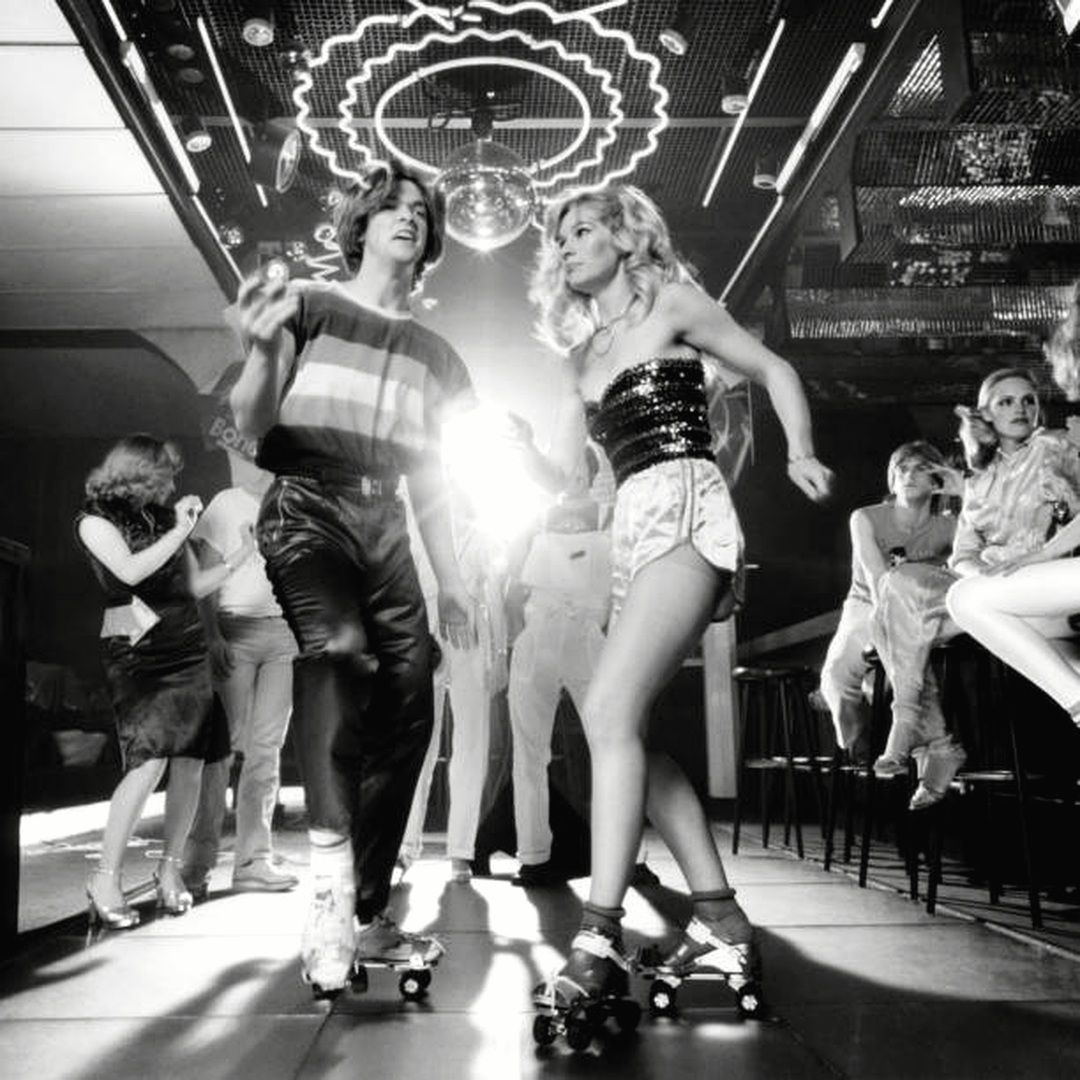
Right up until the 2010s, the halter top was a garment with a curfew. It belonged to the disco and the wedding tent, and in July the UK edition of Who What Wear opened its style guide with the observation that the halter has shed its ‘70s disco roots, predicting in a parenthetical I have now read nine times “a resurgence of Cher-approved styles on the horizon.” I keep going back to confirm the parenthetical is real. It is real. A fashion publication now issues Cher alerts in the middle of a sentence about a top, and the top survived the sentence, which says more than the forecast does.
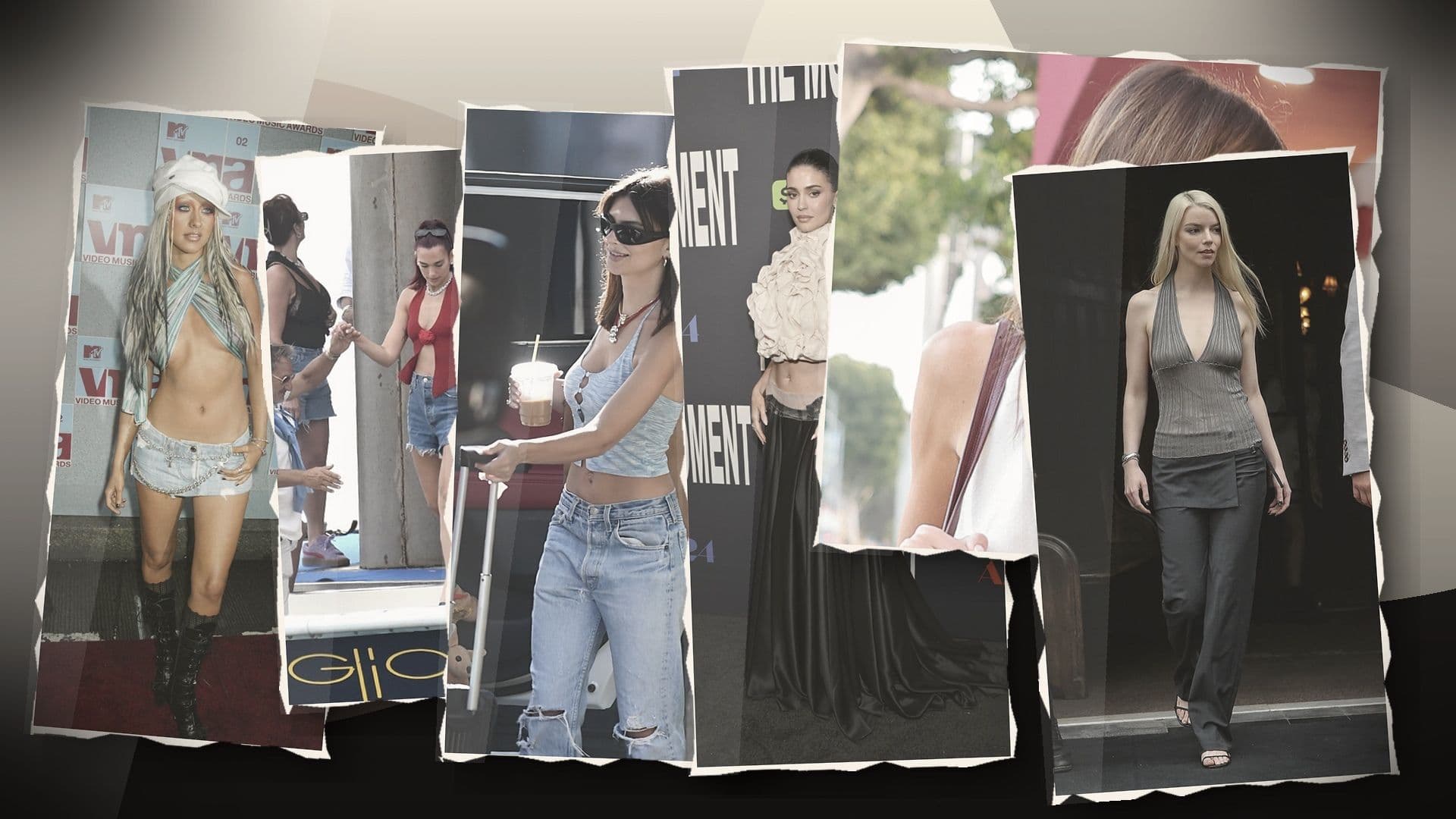
It peaked again at the millennium in the version most people picture, the twist-front with the knot at the back of the neck, the going-out uniform of an entire pop era. I’m looking at you, Christina Aguilera, and the twisted halter you practically trademarked. Then the 2010s arrived with their permanent downward smile, the decade of quiet luxury and cashmere the colour of oatmeal, and a garment that announces itself had no place in it. You cannot whisper in a halter top. That was the problem and, eventually, the entire point.
The current run started before the headlines, when Dua Lipa gave the daytime community permission to experiment, wearing the $149 With Jéan Rose Top in Capri with denim shorts as if it were nothing. The internet filed it under vacation. Then EmRata wore a Mango halter marked down to $30, and Who What Wear ran the line that she has “access to nearly every luxury brand under the sun,” and that the writer therefore notices when she wears something affordable. That sentence is the entire celebrity-fashion economy in one breath. The $30 top sold out within days. I know because I checked, and a man writing about women’s tops has to do his homework, and my homework that week was refreshing a Mango product page eleven times like it owed me money.
First came Dua in her rose knit, then EmRata cleared the Mango stockroom, and now the halter has joined the white tee in the arena of the basic. No longer does the halter have to hide behind the illusion of a “going-out top”—who were we kidding?—the era of “the halter basic” is here.
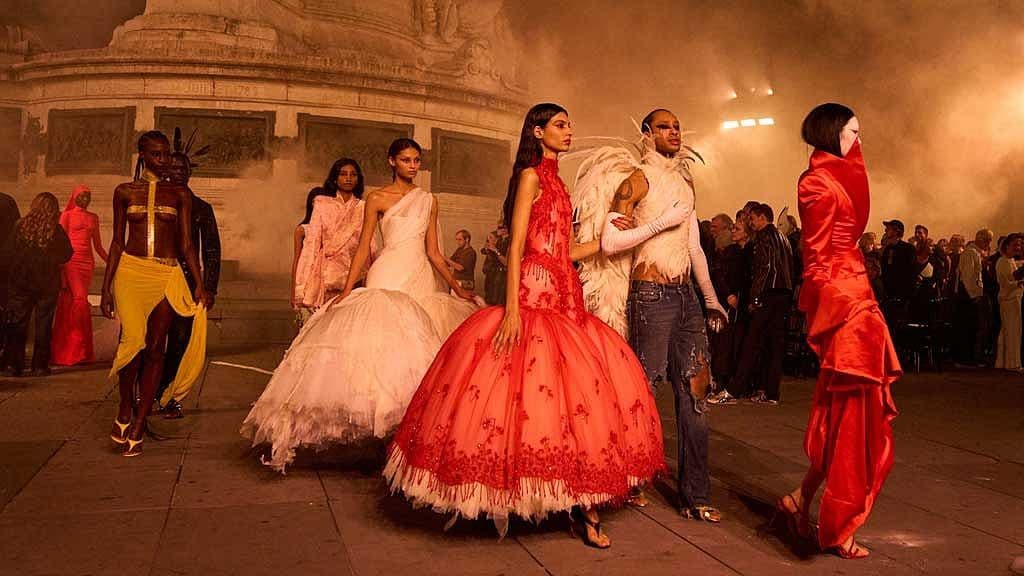
Then the runway got involved, which is where it gets fun. Glenn Martens put a ruffled cream halterneck in his debut Margiela collection, and Kylie Jenner wore it out of the show and onto a red carpet, removing the panel over the navel, which is the kind of edit a person makes when she plans to be seen in a garment twice. By May, WWD was running “The Y2K Halter Top Is Officially Grown-up” and describing Jenner’s version as “decidedly polished rather than overtly Y2K.” The word doing the work in that sentence is “decidedly.” WWD decided. Everyone else retweeted.
By April, searches for “halter top” had hit their highest point in a year, and my first reaction was offense. The garment had been winning for two years, and the internet only noticed when the weather turned. I checked the date twice, the way you do when a number agrees with your timeline. Charts are shit at timing.
If you want proof the demand is real, watch the TikTok tracker instead: creators keep cutting halternecks out of T-shirts. Would you cut up a shirt you were merely curious about? People do not ruin good cotton for a garment they plan to think about once.
And here is the part that genuinely moved me. Kaia Gerber wore the white All My Love halter in May, draped cowl-neck, open back, low-slung indigo jeans, thin black ballet flats, and on her arm the burgundy Chanel Maxi Flap from Matthieu Blazy’s first collection, which Vogue described as fetching “a cool $9,300.” Two hundred dollars of top standing next to nine thousand three hundred dollars of bag, and the top did not apologize. At that point it stops being styling and starts being arithmetic. My resistance broke somewhere between the $200 and the $9,300. That is the short version. Searches spike. Runways move on. The ratio is the only fashion math I trust, and a halter is a halter no matter what is standing next to it.
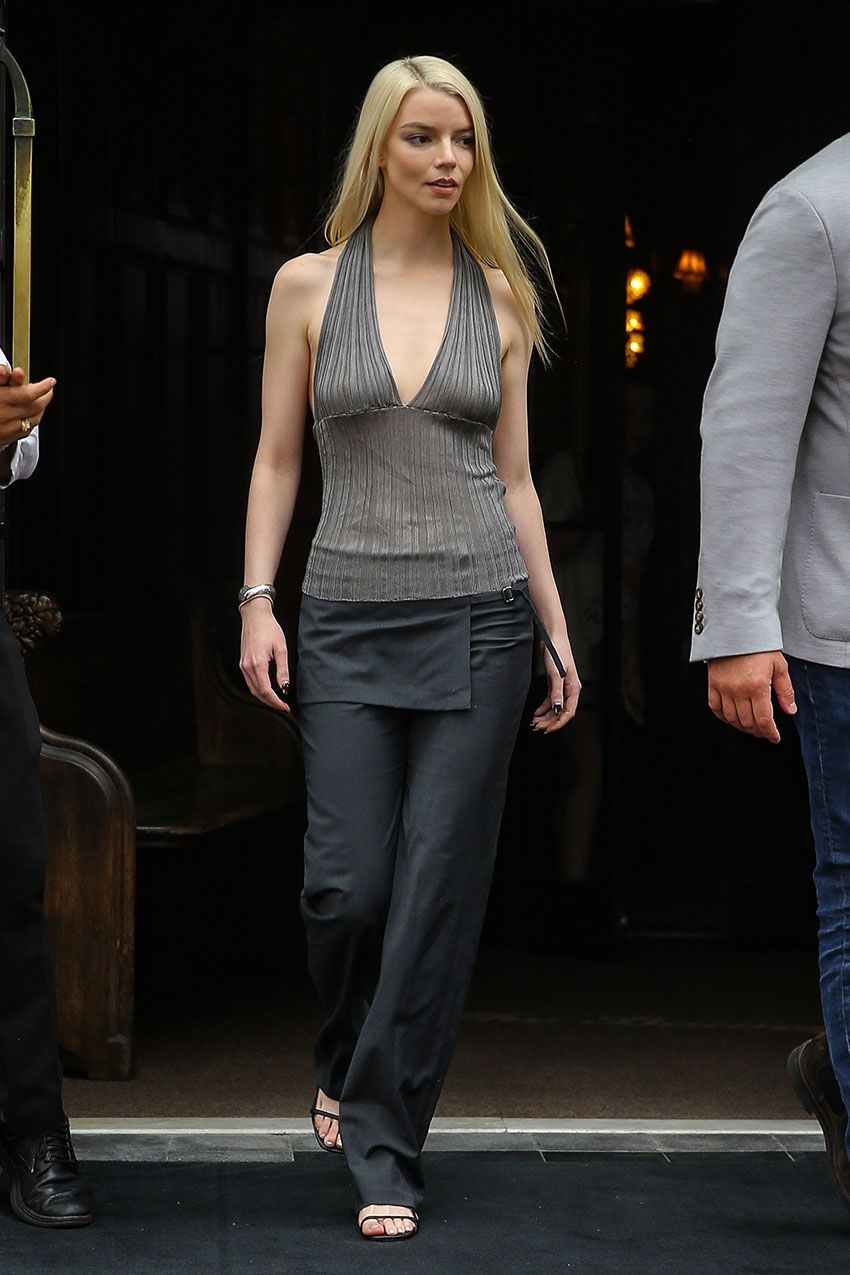
A good halter turns the neckline into architecture. One strap carries the whole silhouette and everything below it agrees to be quiet. I say this as a man who has stood next to these outfits at parties and watched them work, which is the only honest way to report on a garment you cannot wear. There are two kinds, and they demand different levels of trust: the one you tie yourself, and the clasp you cannot reach behind your own neck. Most people end up tying, which is the garment’s quiet way of telling you who it belongs to. Anya Taylor-Joy wore a grey plissé version from Gimaguas, $225, in July, under a headline calling the style “dated” while proving it was not, one color top to bottom, pants with a skirt attached. The straps did all the geometry. These outfits do not look effortful. That is the point.
A white tee forgives everything. Bad days, long flights, an unwashed ponytail. A halter is an announcement. You cannot be too old or too young for a neck, and that is the entire dare. Kylie’s halter came with a premiere to walk into. Kaia’s came with jeans and a bag that costs more than most cars. The garment did not blink either time.
The white tee passes the basic test because it exists at every price and still works. The halter now clears the same bar. EmRata’s was $30, Dua’s $149, Kaia’s under $200, Anya’s $225, and the Margiela version Kylie wore was never meant for a price tag at all. And at the bottom, the $12 rack version: turn it inside out at the rail and the shelf bra is a folded strip of the same fabric, more suggestion than support, the seams already giving up. A garment that shows up at $12 and at a couture house in the same week is inventory. That is what basics are.
Strip away the styling, a halter is really just a fancy vest with ambition, and ambition is one fabric men understand. We spent years pretending we needed nothing but a wallet and two pockets, and look where that got us: bulging at the seams while a knot did all the work. (Acceptable only for the very brave and the very heat-adapted!) So personally, I am thrilled for the halter, the way a man who cannot dance is thrilled for the dance floor. I will never wear one, and I finally know what they do.
The crewneck will be fine. It is the dress watch of tops, the basic that survives on restraint, and nobody has ever needed to explain one, which is the entire argument for it and the entire argument against it.
I will keep my white tees. They are my inheritance, and I am not sentimental about them, which I suppose is the point of an inheritance. But the next time I see a halter top, it will probably be a Tuesday, on a instagram, over jeans, doing absolutely nothing special, and that will be the proof the search charts never were.
Move over, white tee. It’s Tuesday. Come here White Halter Top.