The hottest fashion product on the planet between April and June 2026 cost $37 and came with an adjustable strap.
That isn't a guess. It comes from the Lyst Index, the quarterly ranking fashion brands screenshot and post when they win. Scroll to the bottom of Lyst's Q2 2026 page and the Hottest Products grid opens on a blue baseball cap with an orange logo, sitting at 01. Just below it, at 02, is Issey Miyake's Madame-T stole, which Gear Patrol prices at more than $400. Chanel's shield sunglasses are down at 07. The brand ranking on the same page starts with Chanel, then Miu Miu, then Dior. In that company, the product everyone wanted most was a New York Knicks hat you can buy on the NBA Store for $37.
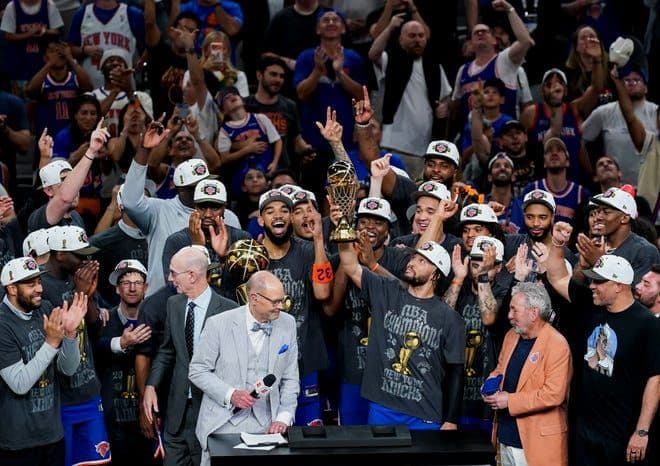
Searches for it rose 4,276% quarter on quarter. On June 13, the Knicks beat the San Antonio Spurs 94-90 to close out the Finals in five and win their first NBA title since 1973. Fifty-three years of waiting ended. A whole city, then a good part of the internet, reached for the same accessory.
Call it a sports story if you want. Lyst won't.
Its own write-up calls sport "one of the industry's more powerful discovery engines." The company credits highlight clips, athlete tunnel fits, and fan-made videos with pushing clothes to people who were never looking for them. Read that again with a fashion executive's eyes. The company whose data is built on luxury shoppers says a growing share of those shoppers now find what they want during a game.
Think about how you found the last thing you wanted to buy. Was it a runway show?
For most people in 2026, probably not. The path runs more like this. You're watching highlights on your phone. A fan in the stands is crying into a blue cap. The next clip shows a celebrity in the front row wearing the same colors. Then your feed hands you a restock alert.
Nobody in that chain set out to sell you a hat. They sold you a hat anyway.
THE WAVE STARTED EARLY
The Knicks numbers show how early the wave started. On June 12, before the Finals were even over, a Lyst Data Drop by PR manager Josie Chapman reported that demand for Knicks merchandise on the platform had already jumped 458%. Caps, basketball shirts, and vests led the category. The same post described a one-point win with two seconds on the clock, and Taylor Swift in the building. Then came Game 5, and Jalen Brunson's 45 points in front of a crowd that included Timothée Chalamet, Ben Stiller, and Prince Harry. Within hours, official gear was selling out in size after size on Nike and Fanatics.
After that, the merch went a little feral. Fanatics printed the New York Post's June 14 front page onto a T-shirt, with the "We're Number Brun" sports cover on the back. FOCO released a hand-painted Knicks garden gnome. Then it released blind-box plush bag charms, built on the same pull-a-surprise mechanic that made Labubu a cult. A basketball team was selling to the Labubu crowd. That crowd was buying.
The impressive part is this. A basketball game turned a New Era cap into a search term that outran Gucci heels for an entire quarter. No campaign shoot or seeding list did that. Brunson did it with a basketball, and he never touched the product.
THE JERSEY THAT NEEDED A RUNWAY
Basketball wasn't the only sport in the index. Lyst recorded a 60% rise in searches for football-inspired fashion heading into the World Cup. The adidas x Willy Chavarria jersey climbed to No. 9 on the product list after a 373% jump in demand. Its backstory is the most interesting thing in the whole report.
Chavarria first showed adidas football pieces on his Autumn/Winter 2026 runway in Paris. He then reworked Mexico's 1986 home jersey for the national team, in a shade called Collegiate Green. It went on sale June 10 for $200. The next day, the World Cup opened with Mexico beating South Africa at the Estadio Azteca.
The shirt was made on a runway. Most of its buyers found it at a football match.
That sequence should bother anyone who wants a clean story in either direction. Fans of "sport killed the catwalk" have to explain why the most fashion-literate item on Lyst's sport list started at a Paris show. Defenders of the catwalk have to explain why most of its buyers first saw it on a federation crest.
Nike bet on volume. Its X2 project paired seven designers with seven national teams: Palace for England, Slawn for Nigeria, Patta for the Netherlands, and Jacquemus for France among them. Lyst also clocked a 38% month-on-month jump in polo shirt demand, with Burberry holding three of the category's five hottest spots.
TENNIS, AND LUXURY'S CLEAREST WIN
Then there's tennis, which gave luxury its clearest win. Miu Miu climbed two places, and Lyst linked its 30% demand increase to crochet bags, sunglasses, and the New Balance collaboration worn by Coco Gauff. The timing is tighter than it looks. Miu Miu and New Balance revealed Gauff's Wimbledon capsule on June 23, including two leather versions of the 530 SL sneaker at $1,270. Wimbledon itself ran from June 29 to July 12, so only the reveal and the tournament's first two days fell inside Q2. The quarter's lift came mostly from the announcement, before Gauff had hit a ball.
I noticed it on the World Cup's opening weekend, in a packed room where half the people had come for the football and the rest for the food. A man two seats down wore a green jersey I couldn't place. It was loose in the body, with a collar that looked older than he was. At the break I did what everyone does now. I took a bad photo while pretending to read a message and ran it through a visual search. Before the players walked back out, I had a designer's name, a federation crest, and a $200 price.
I never bought it. By the second half, I still knew more about that shirt than about anything I'd scrolled past during fashion month.
WHERE THE NUMBERS GO SOFT
The numbers deserve a hard look. Some of them are softer than they seem.
Start with how the product list is built. Lyst sifts more than eight million items. Social mentions, searches, page views, interactions, sales. It weighs global demand against stock available. Now add a detail from Gear Patrol: weeks after the Finals, the emblematic New Era cap was still sold out on New Era's own site.
Lyst hasn't published its weights, so what follows is my reading, not its admission. A formula that adjusts for scarcity will flatter a product people want and can't get. The cap may be at No. 1 partly because it was hard to buy.
Then there's what "the cap" even means. Johnny Brayson, the Gear Patrol writer and a Knicks fan since the early '90s by his own account, noticed that Lyst seems to lump every Knicks hat together, from '47 caps to Siegelman Stable. The winner is closer to a category than a product.
The famous number is overhyped. 4,276% sounds seismic, but Lyst publishes no baseline. Nobody reading the report can tell whether first-quarter searches were modest or close to zero. A percentage that size mostly shows how quiet things were before.
One more detail most editors would cut, and I'm keeping it. Lyst's live Q2 page still shows leftover template text: a stat box that reads "XX%," a 2024 Coach figure of 332%, a "WORN BY: XXX" line under Literary Sport, and Voranida's 232% called year-on-year in one spot and quarter-on-quarter in another.
It isn't a scandal. Still, when a placeholder sat on the page the whole fashion media quoted through August, the percentages should be read as direction, not gospel.
The biggest problem is timing. The two loudest examples in the whole report, the cap and the jersey, depended on a Finals run and a World Cup on home soil. Without the trophy and the tournament, nobody knows how much of the curve survives. Whether the Knicks cap is still in Lyst's top ten by autumn is something no one outside the company can say yet. Maybe no one inside it can either.
Even with those caveats, I'll take a position, and some readers won't like it. Sport-led discovery is real. Most of its money goes to whoever holds the license: New Era, Fanatics, Nike, adidas. Luxury houses get a share mainly when an athlete's body carries their product into a camera frame. Miu Miu needed Gauff to wear the shoe. Chanel, the hottest brand in the world by Lyst's count, reached the product list with sunglasses during a heatwave.
Lyst more or less said so itself. It told FashionNetwork that shoppers are "increasingly motivated by product over brand." Follow that logic to the edge of the court. A sponsorship board courtside buys a logo in the background. The clothes an athlete wears walking in are what people search for afterward. Sports marketers who still sell rinkside boards as the main prize won't enjoy that reading. The Lyst data supports it without proving it.
Chavarria keeps the argument honest, since his jersey needed a runway and a World Cup. So here's the narrower claim, and I'll stand behind it. In 2026, a Paris show can still make the object, but most buyers first see it during a game. Any brand that still treats the show as the main event and the stadium as an afterthought has the order backwards.
WHAT THE NEXT INDEX DECIDES
The real test arrives with Lyst's next index, covering July through September. That window holds nearly all of Wimbledon and the World Cup's knockout rounds, ending with Spain's 1-0 extra-time win over Argentina on July 19. It holds no NBA basketball at all. The new season doesn't tip off until October 20, when the Knicks raise their banner at Madison Square Garden. If sport-driven products hold their places without a Finals to lean on, this is a lasting shift in how people shop. If the cap vanishes and only the jerseys survive, the engine runs on events, and someone has to keep feeding it a new one every quarter.
Brayson ended his Gear Patrol piece by telling readers to buy the cap now, so nobody could call them bandwagon fans when the Knicks run it back next year. It was a joke. It may also turn out to be a decent Q3 forecast. When the next index drops, I'll skip past Chanel and scroll straight to the bottom of the page to see what's sitting at 01.